Martian Subvital Units
Last and First MenMartian Subvital Units are microscopic living units whose capacity for independent life and vibration-based coordination made possible a form of organism unlike terrestrial life. They could assemble into conscious cloudlets without continuous material connections between their parts, and their dispersed remains transformed the aftermath of the Martian invasion: first into a prolonged threat to life on Earth, then, across evolutionary time, into the basis of new symbiotic relationships.
Origin and Environmental Advantage
On Mars, the earliest forms of life had developed much as life on Earth had, but the planet’s rapid loss of atmosphere and water vapor pushed its early plants and animals beyond the conditions to which they could adapt. A different kind of organization then gained an advantage. Martian Subvital Units arose from one of the planet’s subvital molecular forms, a kind that had previously failed to evolve and had played little part in life except occasionally as a rare virus in animals’ respiratory organs.
Their first habitats were marshy ponds that dried each spring into baked mud and dust. Carried aloft on dust particles, some kinds adapted to extremely dry conditions: they absorbed chemicals from windborne dust and small amounts of moisture from the air, while using a form of photosynthesis almost identical to that of plants. This combination gave them a way to persist where the older Martian fauna and flora were increasingly ill-suited to the changing environment. Their history thus begins not with the replacement of one successful animal by another, but with a living organization able to exploit a planetary crisis that endangered other forms of life.
Organization and Collective Life
The defining capacity of Martian Subvital Units was their sensitivity to etherial vibrations and their ability to initiate vibrations of their own. Terrestrial organisms coordinate their parts through material contact, especially through nervous systems; the Martian organization described in the book could maintain coordination and unity of consciousness without such continuous physical connection. Units could move freely while exchanging signals, and a multitude of them could sustain contact across distance even though the radiation of any single unit was feeble.
Through specialized magnetic fields, units could attract or repel their neighbors. These forces gave a dispersed system cohesion and a changing but definite outline, with a consistency likened to something between a smoke cloud and a very tenuous jelly. In concentrated formations, their collective pressure could act on surrounding objects with great force, yet could also be controlled for delicate manipulation. The result was not simply a cloud of independent particles: it was an organized living system whose arrangement, contour, and capacity to act arose from the relations among its members.
Within a cloudlet, specialized groups of units performed different functions. Some handled attraction and repulsion, chemical operations, energy storage, radiation, water, or sensitivity to pressure, vibration, temperature, and light. Others served brain-like functions, receiving and correlating messages from across the cloudlet and initiating responses. The organization could fluctuate between individuality and multiplicity: a cloudlet could sometimes act as an individual and sometimes as a swarm of more primitive individuals. At the broader scale, one Martian species formed a vast fluid system of cloudlets that acted as a single-minded host. Its collective life depended on coordination among mobile units, not on a body held together by continuous tissue.
Independent Units and Specialized Functions
The units’ freedom from a single continuous body did not mean that they were always independent of organization. Except for a few highly specialized kinds, they could survive on their own as airborne bacteria or viruses when separated from the radiation of the whole system. They continued their simpler lives until they came again under the cloudlet’s control; normally, electro-magnetic fields directed them to their particular tasks and could hold some in fixed relation to one another.
That collective coordination could produce complex organs. Units specialized to carry water first bore minute globules, then larger droplets supported by millions of members. Their activity ultimately served vision: a cloudlet could arrange a water lens and hold a retina at its focal distance, producing eyes of different kinds as well as telescopes and microscopes. Much of this construction and adjustment was subconscious, though the civilized Martians had increased their conscious control of physiological processes. These examples show how the units’ distinctive biology joined mobility with precise organization: structures that would be fixed organs in a terrestrial animal could instead be assembled and maintained by coordinated free-floating members.
Invasion and Biological Aftermath
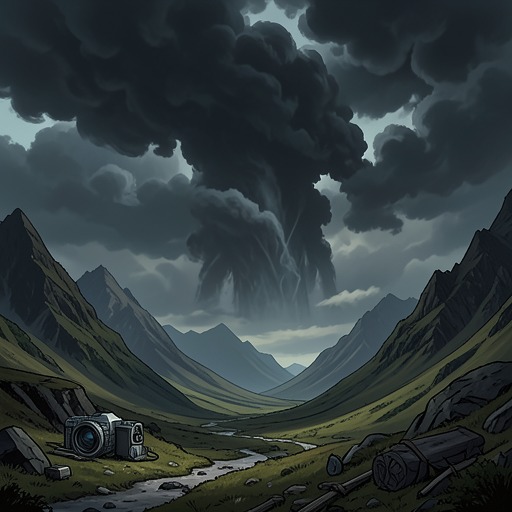
While integrated into the living Martian cloud, the units could enter a human body without causing permanent harm. The defeat of the invading host changed their relation to other life. Dispersed across Earth as an ultra-microscopic dust, they were no longer functioning members of a higher organization and became predatory viruses. Once inhaled into human lungs, they adapted to the new environment and disrupted human tissues, with infected cells losing their own constitution. The human victory over the Martian collective therefore did not end the threat: the defeated organism’s living components remained active in a different form.
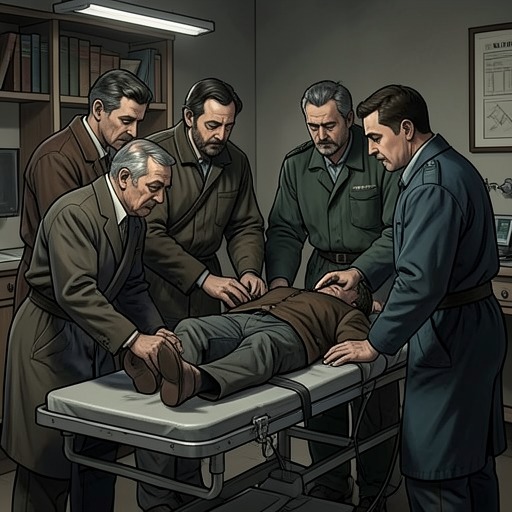
The infection’s effects outlasted the period in which it could be controlled. Research eventually found a way to check it, and after years of rigorous purging the air and human bodies were clean again. But the generations already stricken did not recover, their tissues having been too seriously damaged; their fertility was greatly reduced. The surviving population consequently consisted of a small number of healthy people below middle age and a much larger group of ageing invalids. Their weakening endurance and competence made the social consequences persist even after the infection itself had been brought under control. The units thus altered human history not only through the invasion but through the delayed, generational consequences of their dispersed survival.
From Parasite to Symbiotic Partner
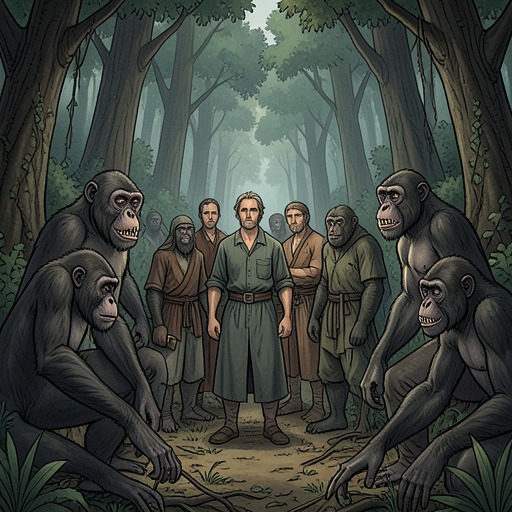
The long aftermath did not preserve the same relation between the units and terrestrial life. Over millions of years, some mammalian species became adapted to them until the former viral parasite was harmless and necessary to its host. The relationship became a cooperative partnership: terrestrial animals gained something of the distinctive attributes once associated with Martian organisms. The units’ history therefore crossed a sharp reversal, from agents that damaged human and animal life after the invasion to partners incorporated into the well-being of some mammalian lineages.
Humanity eventually regarded those animals with envy and made use of the Martian virus for its own enrichment. The account does not specify the practical means or extent of that later use, but it establishes a final change in the units’ place in history. They are neither merely an alien weapon nor a remnant of a vanished civilization. Their persistence connects planetary change, biological adaptation, catastrophe, and later appropriation: a form of life first enabled by Mars’s environmental decline continued to shape life on Earth long after the organized Martian host had disappeared.